How to Measure ROI on a Corporate Event Photo Booth
What if the busiest photo booth at your corporate event still couldn’t prove its value? High participation can create energy, memorable images, and a polished brand moment, but activity alone doesn’t show whether the experience advanced a business goal. That’s the challenge of measuring ROI on corporate event photo booth activations: connecting what guests do with outcomes stakeholders can assess.
A credible evaluation starts before the event. Choose KPIs that reflect your objective, whether that’s encouraging participation, generating qualified leads, or creating branded content. Then separate outcomes you can directly attribute to the booth from softer indicators, such as guest enthusiasm or the quality of the experience. A print, photo, 360 video, or message booth may produce different evidence, so compare formats against the same goal rather than treating every output as equal.
This guide explains how to set relevant measures, assess results fairly, and prepare a clear post-event ROI report. You’ll learn how to account for the activation’s cost, present attributable value without overstating it, and give stakeholders a grounded answer to the question: was it worth the investment?
Key Takeaways
- Define ROI as attributable benefit compared with the full activation cost, using one consistent calculation.
- Choose KPIs that match your event objective, and distinguish measurable outcomes from softer signs of guest engagement.
- Compare print, photo, 360 video, and message booth experiences by their outputs and measurement limitations, not by assumed performance.
- Use a pre-event plan to assign data owners, establish a baseline, and decide how results will be reviewed.
- Measuring ROI on corporate event photo booth experiences starts with asking partners what data they can provide and setting realistic expectations for what the activation can prove.
What does ROI on a corporate event photo booth actually measure?
A photo booth can create a lively moment: colleagues gather, branded images circulate, and guests leave with something memorable. Stakeholders may still ask what that moment contributed to the business. Measuring ROI on corporate event photo booth activity means looking beyond how busy the experience appeared and assessing whether it delivered value tied to the event’s goals.
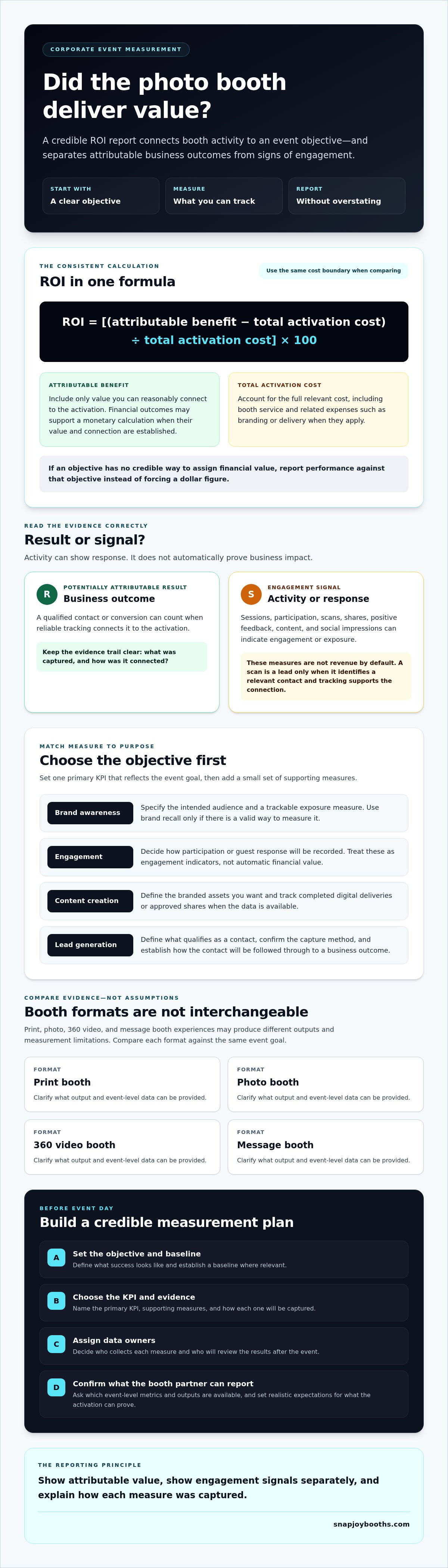
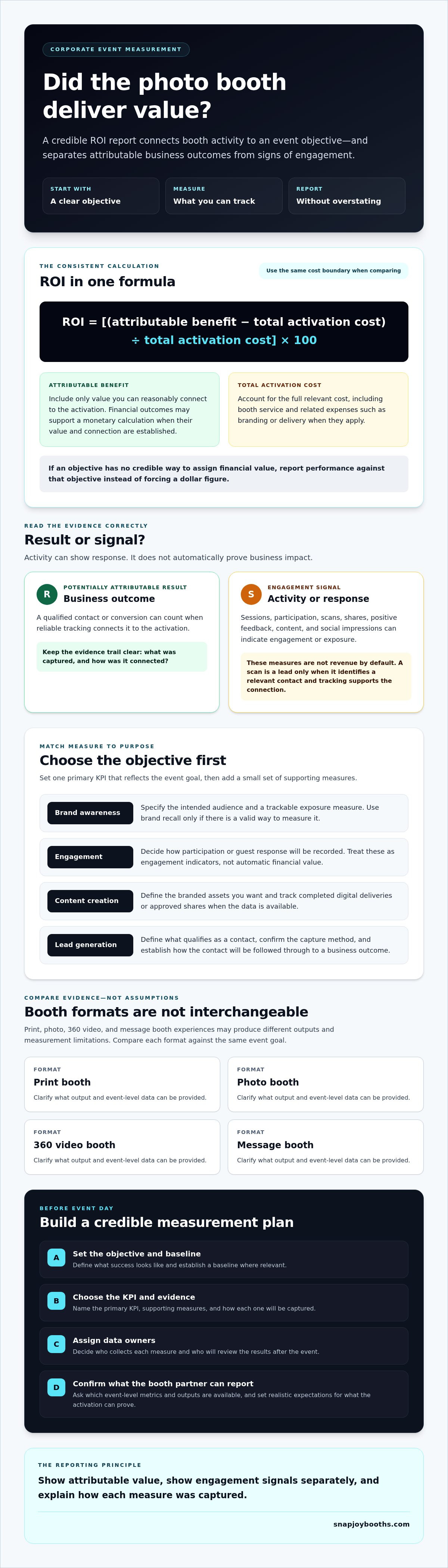
Return on Investment (ROI) compares a benefit with the cost required to achieve it. For an event activation, use:
ROI = [(attributable benefit − total activation cost) ÷ total activation cost] × 100
Include only benefits you can reasonably connect to the activation, and account for the full relevant cost. Financial outcomes, such as attributable sales or qualified opportunities with an established value, may support a monetary calculation. Participation, guest feedback, content created, and social impressions can show engagement or exposure, but they aren’t revenue by default. If an objective has no credible way to assign financial value, report performance against that objective instead of forcing a dollar figure.
Which corporate event objectives can a photo booth support?
Set the objective first, then define what success will look like. For brand awareness, specify the intended audience and a trackable exposure measure. For engagement, decide how you’ll record participation or guest response. For content creation, define the branded assets you want produced and how you’ll use them. For lead generation, establish what qualifies as a contact and how you’ll follow it through to a business outcome.
For example, a Miami brand activation might prioritize shareable branded content, while a corporate gathering could focus on guest participation. These are planning scenarios, not promises of results. The right measure depends on the audience, purpose, and tracking available.
What counts as a result, and what is only a signal?
Classify outcomes before reporting. A qualified contact or conversion can be a directly attributable result when reliable tracking connects it to the activation. Booth sessions, participation, scans, shares, and positive feedback are useful signals, but they show activity or response, not necessarily business impact. Treat a scan as a lead only if it identifies a relevant contact and your tracking supports that connection.
Event ROI is the value an activation can credibly attribute to its cost, not a tally of activity presented as impact. Keep financial outcomes and engagement indicators distinct, and explain how each metric was captured. This makes the evaluation more honest, whether the result is a positive return, a useful engagement signal, or insufficient evidence to claim either.
How to calculate corporate event photo booth ROI with the right KPIs
A useful calculation starts with two consistent inputs: the value attributable to the activation and its total relevant cost. Use this formula:
ROI = [(attributable value − total activation cost) ÷ total activation cost] × 100
Count the booth service and other expenses directly tied to the activation, such as related branding or delivery costs, if they apply. Use the same cost boundary when comparing events or experience formats. For a broader perspective on event measurement and attribution, consult Bizzabo’s guide to event ROI.
Choose one primary KPI that reflects the event’s stated objective, then add a small set of supporting measures. A lead-generation activation might prioritize qualified contacts, with completed booth sessions as a supporting indicator. A content-focused experience might prioritize completed digital deliveries, if those figures are available. Keep engagement indicators separate from financial value: don’t assign revenue to a scan, share, or impression without a defensible link to a business outcome.
How should you choose KPIs before the event?
For awareness, define the intended audience and use qualified exposure or brand recall only if you have a valid way to measure it. For content, identify the assets you want and track completed deliveries or approved shares when those data can be provided. For leads, define what makes a contact qualified and confirm that the chosen capture method is available and appropriate before the event. Ask in advance which event-level metrics the booth partner can report.
How do you calculate value without overstating attribution?
Give each outcome a clear trail. A unique campaign link, QR code, or UTM parameter can help connect a booth interaction to a landing-page visit or conversion, but only if it’s implemented and tracked. CRM comparisons may show what happened after an event, provided contact matching, consent, and the review window are appropriate. Separate directly attributed value from influenced value, and document assumptions, exclusions, and gaps.
For example, if an attendee uses a tracked campaign link and later completes a defined conversion, you may be able to connect that outcome to the activation. If branded content is shared but no downstream action is tracked, report the share as an engagement measure, not sales value. That distinction makes measuring ROI on corporate event photo booth activity more credible, even when the evidence is mixed.
Before selecting a format, compare the outputs you need to evaluate with the measures you can access. You can explore corporate event photo booth experiences and consider which option best fits your objective and measurement plan.
Which photo booth experience best fits your corporate event ROI goals?
The right format produces an output suited to your objective and audience, within the space and tracking setup available. A tangible keepsake, a digital image, a short-form video, and a guest message each create a different kind of evidence. None guarantees stronger ROI. When measuring ROI on corporate event photo booth activations, compare the experience with the outcome you plan to evaluate, then confirm what can actually be tracked and reported.
| Experience | Possible objective and output | What to assess before booking |
|---|---|---|
| Print booth | Guest engagement or brand awareness; a customizable printed keepsake provides a visible branded output. | Consider whether guests will value a physical memento, where the experience can sit without disrupting venue flow, and how print quantities or usage will be recorded. Confirm the staffing and setup requirements. |
| Photo booth | Digital content creation or sharing; instant digital delivery can give guests an image to keep or share. | Best aligned when digital use is part of the campaign plan. Clarify what delivery metrics are available, and whether sharing can be tracked rather than assumed from delivery. |
| Message booth | Guest engagement or collecting reflections; the intended output is a set of messages or responses. | Define how messages will be gathered, stored, and used, and explain that purpose to participants. Confirm the collection process, consent approach, staffing, and which outputs can be reported. |
| 360 video booth | Dynamic content creation or audience engagement; the observable output is a completed video delivered to a guest. | Consider whether the format suits the event’s energy and visual identity, whether the venue has suitable floor space, and what staffing is needed to keep participation orderly. Verify whether delivery or usage metrics are available. |
When might print, photo, or message experiences make sense?
Choose prints when a tactile, branded keepsake is central to the guest experience. Choose a photo experience when digital delivery supports a defined content objective, not simply because sharing seems likely. A message experience may suit an event seeking guest reflections, provided the collection, consent, and intended use are clear. SnapJoy’s South Florida corporate event photo booth guide offers broader activation-planning context.
When might a 360 video booth fit the activation?
A 360 video experience may suit an audience drawn to expressive, moving content, but the format should complement the event rather than disrupt its flow. Assess usable floor space, the look and feel of the content, and how guests will receive it. Count completed, delivered videos separately from verified reach, engagement, or conversions. For format-specific considerations, see this 360 video booth rental guide for South Florida.
How to build a credible photo booth measurement plan before event day
A polished activation deserves a measurement plan with the same care as its visual presentation. Before guests arrive, decide what you’re trying to learn, where the evidence will come from, and who will gather it. This preparation makes measuring ROI on corporate event photo booth activity more reliable, whether the goal is awareness, content, engagement, or qualified leads.
What should the team prepare before guests arrive?
Work through the plan in sequence, and assign an owner to each step:
- Objective: Record the campaign purpose and target audience.
- Baseline: Note the relevant pre-event measure, such as existing campaign performance or brand recall, if you have a valid way to compare it.
- KPI: Define one primary measure, supporting indicators, and what counts as success.
- Tracking setup: Test campaign links, QR codes, analytics events, and any CRM handoff. Agree on consent language, data access, and who can use collected information.
- Event execution: Confirm who records booth activity, manages tracking, and notes issues that could affect the data.
- Post-event review: Set the reporting window and name the person responsible for reconciling results.
Record the full relevant activation cost, not just the booth service. Include other directly related expenses and document who owns each data source, such as campaign analytics, CRM records, or booth usage and delivery metrics. Confirm with the provider in advance which guest interactions and delivery measures are available. Don’t build a KPI around data you may not receive.
For additional context on planning an activation in Miami, see this Miami brand activation photo booth article.
How should the team assess results afterward?
Use the definitions and time window agreed before the event. Reconcile booth measures with campaign analytics and CRM records only where the data can be appropriately matched. Present activation spend, directly attributable outcomes, proxy indicators, assumptions, and limitations separately. If a metric is missing, disclose the gap rather than filling it with an estimate.
A concise takeaway should name the event, measurement period, and verified outcome. Use a sentence structure such as: “At [event], from [start date] to [end date], the activation recorded [verified result], measured through [source].” Replace every bracket with confirmed information before sharing the report. This keeps the finding specific without suggesting more certainty than the evidence supports.
Ready to consider which experience fits your measurement plan? Explore corporate event photo booth experiences.
How to choose a corporate event photo booth partner for measurable outcomes
A strong partner should understand both the atmosphere you want to create and the evidence your team needs afterward. A polished activation can invite participation and support campaign goals, but it can’t guarantee leads, conversions, reach, or ROI. When measuring ROI on corporate event photo booth experiences, confirm the operational details and available data before relying on them in your measurement plan.
What should you ask a booth provider before booking?
Make the conversation specific to your objective. Ask what outputs and event-level usage or delivery metrics are available, and get confirmation before making any metric part of your evaluation. Clarify who handles setup and on-site operation, how guests receive digital content, what customization is included, and who owns post-event reporting. Also ask how the provider will coordinate with your campaign links, analytics, or CRM process, if those are part of your tracking plan.
SnapJoy Photo Booth Co. offers print, photo, 360 video, and message booth experiences. Professional on-site attendants are included in service packages; instant digital delivery and customizable prints are described as package features. Confirm the specific inclusions, data availability, and responsibilities for your event rather than assuming every feature or metric applies to every format.
How can the activation feel polished and remain accountable?
Discuss how the experience will fit the venue, audience, and visual standards of the event. Thoughtful presentation, suitable lighting, and a clear guest flow can help the booth feel integrated rather than incidental. Keep measurement transparent and discreet: explain any information collection clearly, and avoid tracking steps that feel unexpected or interrupt the guest experience.
Before the event, agree on who monitors the activation, who can access any data, and who will share the results. A provider’s role is to deliver the agreed experience and clarify the outputs it can supply; your marketing or event team should define how those outputs connect to business outcomes. Clear ownership helps prevent missing data and inflated claims.
Miami and South Florida planners can discuss a corporate photo booth experience by sharing the event objective, preferred format, venue considerations, and measurement plan. That conversation can help establish what the experience includes and which results can realistically be evaluated.
Make your next activation memorable and measurable
A confident ROI assessment begins before the event: choose an objective, define a primary KPI, and confirm how results will be tracked. Afterward, separate outcomes you can directly attribute from useful but softer signals such as participation, content delivery, or guest response. That clarity makes measuring ROI on corporate event photo booth experiences more credible, even when the data doesn’t support a direct financial claim.
The right format should serve both the audience and the outcome you want to evaluate. SnapJoy Photo Booth Co. offers print, photo, 360 video, and message booth experiences. Service packages include professional on-site attendants, while instant digital delivery and customizable prints are described as service features. Confirm which options and measurable outputs fit your specific event.
For your next Miami event, share your objective, venue, preferred format, and measurement plan to begin a practical conversation. Discuss a corporate photo booth experience for your next Miami event, and shape an activation that feels considered from the first guest interaction to the final report.
Frequently Asked Questions
How do you calculate ROI on a corporate event photo booth?
Calculate ROI by subtracting the total activation cost from the attributable value, dividing the result by the total activation cost, and multiplying by 100. Include the booth service and other directly related expenses in the cost figure. Only count benefits you can credibly connect to the activation, such as a tracked conversion. If you can’t assign a defensible financial value, report the outcome as an engagement measure rather than presenting it as monetary ROI.
What KPIs should I track for a corporate event photo booth?
Choose KPIs based on the event’s primary objective. For lead generation, track qualified contacts and their subsequent progress if your data and consent process support it. For content, consider completed digital deliveries or approved shares if those metrics are available. For awareness or engagement, participation, guest feedback, or a valid brand-recall measure may be relevant. Select one primary KPI, define it in advance, and treat supporting indicators separately from financial outcomes.
Can a photo booth generate measurable leads at a corporate event?
It can support lead measurement if the selected experience includes an available, appropriate capture method and your team defines what qualifies as a lead. Confirm the capability with the provider before booking; don’t assume every booth format collects contact details. Explain data collection clearly, obtain suitable consent, and agree on how contacts will be matched to later outcomes. A captured contact is not automatically a qualified lead or a conversion.
How can I attribute social media engagement to an event photo booth?
Use trackable campaign links, QR codes, or UTM parameters when they’re configured and monitored, and establish how you’ll identify event-related content. Record measurable actions such as tagged posts, tracked visits, or interactions where the data is accessible. Treat shares and estimated exposure as engagement indicators, not revenue by default. To claim business impact, connect the activity to a defined downstream outcome and disclose any gaps in tracking.
Is a 360 video booth better for corporate event ROI than a print booth?
Neither format is universally better for ROI. A 360 video booth may suit an event seeking dynamic video content, while a print booth can create a tangible, branded keepsake. Compare each against the objective, audience, venue flow, available tracking, and output stakeholders need to evaluate. Then confirm what usage or delivery measures can be provided. The stronger choice is the format that fits your goal and can be assessed fairly.
What should be included in a corporate event photo booth ROI report?
Include the event objective, KPI definitions, measurement period, and total relevant activation cost. Separate directly attributable financial outcomes from indicators such as sessions, deliveries, shares, and guest feedback. Identify data sources, explain attribution assumptions, and note missing information or limitations rather than filling gaps with estimates. A concise report should state what the evidence supports, what it doesn’t, and how the result compares with the goal set before the event.
How do I measure photo booth ROI if I cannot track direct sales?
You can still evaluate performance against a non-sales objective, such as content creation, participation, or guest response. Set the outcome and measurement method before the event, then report verified outputs separately from financial return. For example, completed content deliveries may show that the activation produced assets, but they don’t prove revenue or reach. If no attributable financial value is available, be transparent that monetary ROI can’t be calculated from the evidence collected.
Frequently Asked Questions
Set the objective first, then define what success will look like. For brand awareness, specify the intended audience and a trackable exposure measure. For engagement, decide how you’ll record participation or guest response. For content creation, define the branded assets you want produced and how you’ll use them. For lead generation, establish what qualifies as a contact and how you’ll follow it through to a business outcome. For example, a Miami brand activation might prioritize shareable branded content, while a corporate gathering could focus on guest participation. These are planning scenarios, not promises of results. The right measure depends on the audience, purpose, and tracking available.
Classify outcomes before reporting. A qualified contact or conversion can be a directly attributable result when reliable tracking connects it to the activation. Booth sessions, participation, scans, shares, and positive feedback are useful signals, but they show activity or response, not necessarily business impact. Treat a scan as a lead only if it identifies a relevant contact and your tracking supports that connection. Event ROI is the value an activation can credibly attribute to its cost, not a tally of activity presented as impact. Keep financial outcomes and engagement indicators distinct, and explain how each metric was captured. This makes the evaluation more honest, whether the result is a positive return, a useful engagement signal, or insufficient evidence to claim either. A useful calculation starts with two consistent inputs: the value attributable to the activation and its total relevant cost. Use this formula: ROI = [(attributable value − total activation cost) ÷ total activation cost] × 100 Count the booth service and other expenses directly tied to the activation, such as related branding or delivery costs, if they apply. Use the same cost boundary when comparing events or experience formats. For a broader perspective on event measurement and attribution, consult Bizzabo’s guide to event ROI. Choose one primary KPI that reflects the event’s stated objective, then add a small set of supporting measures. A lead-generation activation might prioritize qualified contacts, with completed booth sessions as a supporting indicator. A content-focused experience might prioritize completed digital deliveries, if those figures are available. Keep engagement indicators separate from financial value: don’t assign revenue to a scan, share, or impression without a defensible link to a business outcome.
For awareness, define the intended audience and use qualified exposure or brand recall only if you have a valid way to measure it. For content, identify the assets you want and track completed deliveries or approved shares when those data can be provided. For leads, define what makes a contact qualified and confirm that the chosen capture method is available and appropriate before the event. Ask in advance which event-level metrics the booth partner can report.
Give each outcome a clear trail. A unique campaign link, QR code, or UTM parameter can help connect a booth interaction to a landing-page visit or conversion, but only if it’s implemented and tracked. CRM comparisons may show what happened after an event, provided contact matching, consent, and the review window are appropriate. Separate directly attributed value from influenced value, and document assumptions, exclusions, and gaps. For example, if an attendee uses a tracked campaign link and later completes a defined conversion, you may be able to connect that outcome to the activation. If branded content is shared but no downstream action is tracked, report the share as an engagement measure, not sales value. That distinction makes measuring ROI on corporate event photo booth activity more credible, even when the evidence is mixed. Before selecting a format, compare the outputs you need to evaluate with the measures you can access. You can explore corporate event photo booth experiences and consider which option best fits your objective and measurement plan. The right format produces an output suited to your objective and audience, within the space and tracking setup available. A tangible keepsake, a digital image, a short-form video, and a guest message each create a different kind of evidence. None guarantees stronger ROI. When measuring ROI on corporate event photo booth activations, compare the experience with the outcome you plan to evaluate, then confirm what can actually be tracked and reported.
Choose prints when a tactile, branded keepsake is central to the guest experience. Choose a photo experience when digital delivery supports a defined content objective, not simply because sharing seems likely. A message experience may suit an event seeking guest reflections, provided the collection, consent, and intended use are clear. SnapJoy’s South Florida corporate event photo booth guide offers broader activation-planning context.
A 360 video experience may suit an audience drawn to expressive, moving content, but the format should complement the event rather than disrupt its flow. Assess usable floor space, the look and feel of the content, and how guests will receive it. Count completed, delivered videos separately from verified reach, engagement, or conversions. For format-specific considerations, see this 360 video booth rental guide for South Florida. A polished activation deserves a measurement plan with the same care as its visual presentation. Before guests arrive, decide what you’re trying to learn, where the evidence will come from, and who will gather it. This preparation makes measuring ROI on corporate event photo booth activity more reliable, whether the goal is awareness, content, engagement, or qualified leads.
Work through the plan in sequence, and assign an owner to each step: Record the full relevant activation cost, not just the booth service. Include other directly related expenses and document who owns each data source, such as campaign analytics, CRM records, or booth usage and delivery metrics. Confirm with the provider in advance which guest interactions and delivery measures are available. Don’t build a KPI around data you may not receive. For additional context on planning an activation in Miami, see this Miami brand activation photo booth article.
Use the definitions and time window agreed before the event. Reconcile booth measures with campaign analytics and CRM records only where the data can be appropriately matched. Present activation spend, directly attributable outcomes, proxy indicators, assumptions, and limitations separately. If a metric is missing, disclose the gap rather than filling it with an estimate. A concise takeaway should name the event, measurement period, and verified outcome. Use a sentence structure such as: “At [event], from [start date] to [end date], the activation recorded [verified result], measured through [source].” Replace every bracket with confirmed information before sharing the report. This keeps the finding specific without suggesting more certainty than the evidence supports. Ready to consider which experience fits your measurement plan? Explore corporate event photo booth experiences. A strong partner should understand both the atmosphere you want to create and the evidence your team needs afterward. A polished activation can invite participation and support campaign goals, but it can’t guarantee leads, conversions, reach, or ROI. When measuring ROI on corporate event photo booth experiences, confirm the operational details and available data before relying on them in your measurement plan.
Make the conversation specific to your objective. Ask what outputs and event-level usage or delivery metrics are available, and get confirmation before making any metric part of your evaluation. Clarify who handles setup and on-site operation, how guests receive digital content, what customization is included, and who owns post-event reporting. Also ask how the provider will coordinate with your campaign links, analytics, or CRM process, if those are part of your tracking plan. SnapJoy Photo Booth Co. offers print, photo, 360 video, and message booth experiences. Professional on-site attendants are included in service packages; instant digital delivery and customizable prints are described as package features. Confirm the specific inclusions, data availability, and responsibilities for your event rather than assuming every feature or metric applies to every format.
Discuss how the experience will fit the venue, audience, and visual standards of the event. Thoughtful presentation, suitable lighting, and a clear guest flow can help the booth feel integrated rather than incidental. Keep measurement transparent and discreet: explain any information collection clearly, and avoid tracking steps that feel unexpected or interrupt the guest experience. Before the event, agree on who monitors the activation, who can access any data, and who will share the results. A provider’s role is to deliver the agreed experience and clarify the outputs it can supply; your marketing or event team should define how those outputs connect to business outcomes. Clear ownership helps prevent missing data and inflated claims. Miami and South Florida planners can discuss a corporate photo booth experience by sharing the event objective, preferred format, venue considerations, and measurement plan. That conversation can help establish what the experience includes and which results can realistically be evaluated. A confident ROI assessment begins before the event: choose an objective, define a primary KPI, and confirm how results will be tracked. Afterward, separate outcomes you can directly attribute from useful but softer signals such as participation, content delivery, or guest response. That clarity makes measuring ROI on corporate event photo booth experiences more credible, even when the data doesn’t support a direct financial claim. The right format should serve both the audience and the outcome you want to evaluate. SnapJoy Photo Booth Co. offers print, photo, 360 video, and message booth experiences. Service packages include professional on-site attendants, while instant digital delivery and customizable prints are described as service features. Confirm which options and measurable outputs fit your specific event. For your next Miami event, share your objective, venue, preferred format, and measurement plan to begin a practical conversation. Discuss a corporate photo booth experience for your next Miami event, and shape an activation that feels considered from the first guest interaction to the final report.
Calculate ROI by subtracting the total activation cost from the attributable value, dividing the result by the total activation cost, and multiplying by 100. Include the booth service and other directly related expenses in the cost figure. Only count benefits you can credibly connect to the activation, such as a tracked conversion. If you can’t assign a defensible financial value, report the outcome as an engagement measure rather than presenting it as monetary ROI.
Choose KPIs based on the event’s primary objective. For lead generation, track qualified contacts and their subsequent progress if your data and consent process support it. For content, consider completed digital deliveries or approved shares if those metrics are available. For awareness or engagement, participation, guest feedback, or a valid brand-recall measure may be relevant. Select one primary KPI, define it in advance, and treat supporting indicators separately from financial outcomes.
It can support lead measurement if the selected experience includes an available, appropriate capture method and your team defines what qualifies as a lead. Confirm the capability with the provider before booking; don’t assume every booth format collects contact details. Explain data collection clearly, obtain suitable consent, and agree on how contacts will be matched to later outcomes. A captured contact is not automatically a qualified lead or a conversion.
Use trackable campaign links, QR codes, or UTM parameters when they’re configured and monitored, and establish how you’ll identify event-related content. Record measurable actions such as tagged posts, tracked visits, or interactions where the data is accessible. Treat shares and estimated exposure as engagement indicators, not revenue by default. To claim business impact, connect the activity to a defined downstream outcome and disclose any gaps in tracking.
Neither format is universally better for ROI. A 360 video booth may suit an event seeking dynamic video content, while a print booth can create a tangible, branded keepsake. Compare each against the objective, audience, venue flow, available tracking, and output stakeholders need to evaluate. Then confirm what usage or delivery measures can be provided. The stronger choice is the format that fits your goal and can be assessed fairly.
Include the event objective, KPI definitions, measurement period, and total relevant activation cost. Separate directly attributable financial outcomes from indicators such as sessions, deliveries, shares, and guest feedback. Identify data sources, explain attribution assumptions, and note missing information or limitations rather than filling gaps with estimates. A concise report should state what the evidence supports, what it doesn’t, and how the result compares with the goal set before the event.
You can still evaluate performance against a non-sales objective, such as content creation, participation, or guest response. Set the outcome and measurement method before the event, then report verified outputs separately from financial return. For example, completed content deliveries may show that the activation produced assets, but they don’t prove revenue or reach. If no attributable financial value is available, be transparent that monetary ROI can’t be calculated from the evidence collected.